


Sign In / Sign Up To Add Wishlist
Wishlist is available for members only. Please sign in or sign up to add your wishlist.
How Brother’s PT-P900W Leads Hong Kong School Libraries Toward Modernization
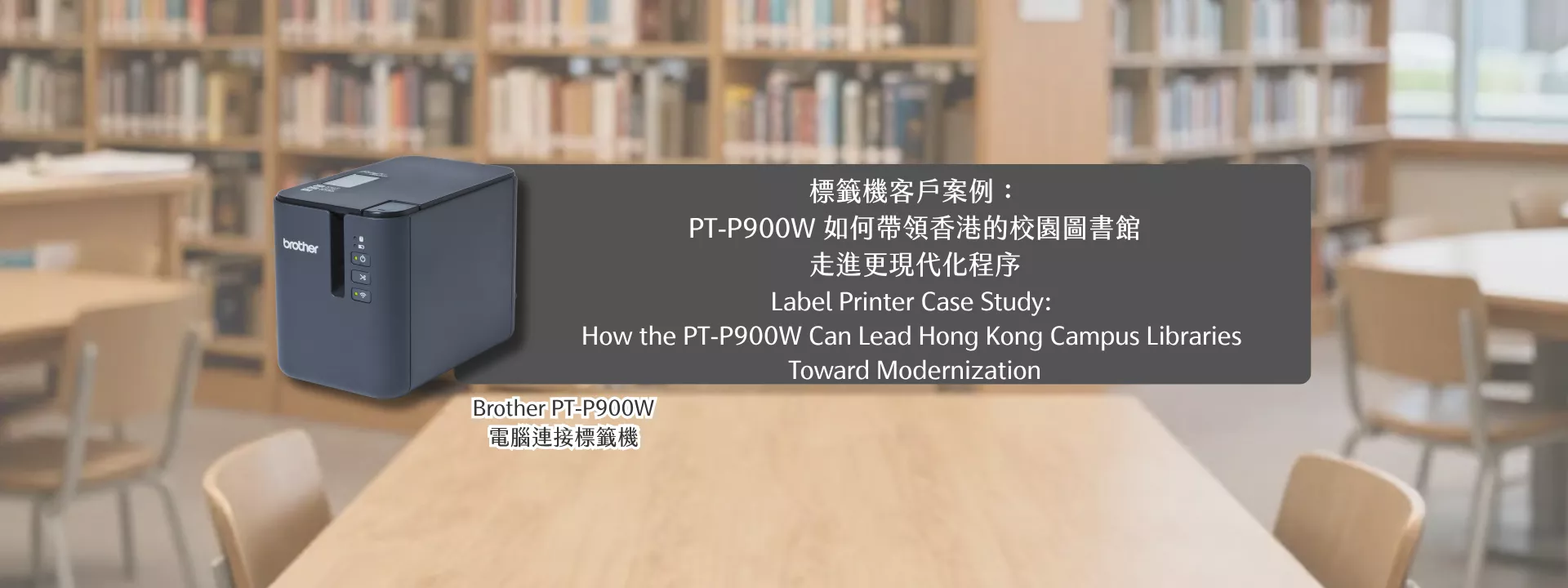

In schools, libraries serve as hubs of knowledge. However, maintaining a clear and visible "identity card" for every single book amidst a vast sea of collections is a major challenge for library staff. Our client—the library of a renowned university in Hong Kong—recently introduced the Brother PT-P900W Business Label Printer, successfully solving long-standing pain points in catalog management. Its outstanding effectiveness has spread through word-of-mouth within the academic community, prompting other universities to quickly follow suit in procurement, jointly establishing automated procedures within the university library sector.
Successful Case: Current Pain Points Faced by University Library
This prestigious university library possesses over 100,000 physical volumes and handles an extremely high daily volume of loans and returns. In the past, the library was plagued by the following issues:
- Paper Labels Prone to Detachment and Fading: Traditional call numbers and barcode labels were printed on paper. After repeated student handling and long-term storage, these labels would easily wear out, fade, or peel at the edges. Library staff frequently had to spend extra time checking, reprinting, and replacing labels, creating a significant additional workload.
- Blurry Labels Lead to High Scanning Failure Rates: Staff would try manually applying a layer of adhesive tape over paper labels to prevent damage, but the quality remained inconsistent. Self-service borrow-and-return machines often failed to read the barcodes accurately, resulting in the need for manual processing by staff, further increasing their workload.
- Procedural Constraints Result in Low Efficiency for Mass Printing: When processing new arrivals or re-cataloging old books, the lack of an automated system meant librarians spent substantial time manually cropping and arranging label layouts. Furthermore, because they were using A4 paper label sheets, staff often had to wait to accumulate a certain quantity of books before printing to avoid wasting the rest of the blank label sheet.
- Massive and Diverse Collections: Beyond physical books, the library holds multimedia discs, rare documents, and even loanable items like tablets and charging cables for students. Items of different sizes require labels of varying widths. The Brother PT-P900W supports tape widths from 3.5mm to 36mm, perfectly addressing this need.
Brother PT-P900W Label Printer is the Perfect Solution for Schools
After the university library fully implemented the PT-P900W Label Printer, their workflow underwent a massive transformation:
- Seamless Batch Printing: With stable Wi-Fi connectivity, the label printer interfaces directly with the Library Management System. The PT-P900W’s built-in automatic full-cutter and half-cut (easy-peel) functions allow librarians to print hundreds of call numbers at once—just a quick peel and stick. There is no need to wait to accumulate a large batch before printing, vastly improving the efficiency of processing new book arrivals.
- Extremely Durable TZe Laminated Tapes: Brother’s patented laminated tapes play a critical role. Their waterproof, abrasion-resistant, and fade-resistant properties ensure that labels affixed to book spines remain smooth and as good as new, even after countless loan cycles. Furthermore, should a label need replacement in the future, it leaves no adhesive residue, ensuring precious books are not damaged.
- Precise Barcode Reading: Boasting a high resolution of up to 360dpi x 720dpi, every QR Code and Barcode is printed with extreme clarity. The fade-resistant properties ensure they endure repeated borrow-and-return processes. Consequently, the reading success rate of self-service machines has reached nearly 100%.
- Seamless Integration with Automation Programs: To support different systems integrators, the library can utilize Brother’s Software Development Kits (SDKs) to achieve seamless integration. These kits are available for Windows®, iOS®, and Android™ systems. The printer also supports various print command languages including ZPL II emulation, Raster, and CPCL emulation, making it easy to integrate label printing functionality into any existing system to assist staff with new book cataloging or re-cataloging.
- Human Resource Allocation: University libraries often employ a large number of student assistants to handle shelving work. A labeling solution that offers stable connection, automated typesetting, and an automatic cutter minimizes human error, allowing professional librarians to focus on higher-level academic support services.
Due to the remarkably visible results—saving substantial working time and improving efficiency for responsible staff—a representative from another university, which was struggling with old label wear-and-tear, immediately procured the Brother PT-P900W Label Printer for their library after an on-site visit.
Beyond Universities: Can Primary and Secondary School Libraries Apply This Solution?
While primary and secondary schools may not have catalog volumes as large as universities, their application scenarios have unique demands:
- Addressing Challenges of High-Frequency Use by Students: In primary and secondary school libraries, books undergo daily borrowing, reading, and transportation, inevitably facing dampness, wear, or impact. Brother TZe laminated tapes, with their waterproof and excellent abrasion-resistant properties, remain clearly readable despite frequent use. This reduces label detachment or damage, making library management easier and more efficient.
- Convenience for Student Librarians: Primary and secondary school libraries rely heavily on student helpers. The operation of the PT-P900W is intuitive. Combined with the easy-peel backing design, even primary school students can easily assist in affixing call numbers to new books without the fear of scissors injuring their fingers.
- Expansion to School Asset Management: In recent years, primary and secondary schools have actively promoted STEM and e-Learning, purchasing large quantities of iPads, laptops, robotics kits, etc. This commercial-grade label printer serves "one machine for multiple uses." Beyond books, it is perfectly suited for labeling school IT equipment for asset management. The high resolution makes it convenient for IT teachers to label, mark, scan, and conduct inventory checks.
Conclusion
Whether for top-tier academic institutions or local primary and secondary schools, campuses are actively pushing for digitalization and modernization. Equipment and asset management have increasingly become an indispensable part of school operational planning. Among these, library collection management is often one of the application scenarios where the effectiveness of label management is most immediately visible. By introducing labeled asset management, schools can effectively improve the efficiency of book tracking, inventory, and loan management.
Brother’s high-efficiency, durable, and automated labeling solutions, specifically designed for school environments, assist schools in establishing a more complete asset management system, becoming an important cornerstone for promoting school modernization.
To help schools experience the practical benefits of label management first-hand, Brother is now launching a School Free Trial Program. Schools can first test the relevant application solutions in the library or on designated asset management projects, deploy fully after assessing the effectiveness, and transition toward smart campus management with a lower barrier to entry.

Brother Hong Kong Genuine Products: Why official channels give you more than a lower price
When choosing a printer, label printer, sewing machine or consumables, many customers compare prices across different channels. A common question is: “Is it really worth buying through Brother Hong Kong official channels?”
In fact, buying through official channels is not just about the product itself. It also means local support, genuine quality and after-sales protection designed for the Hong Kong market. The advantages below can help you make a more confident choice.

TZe Laminated Label Tapes help the Modern Families and Back-to-School Preparation
Every back-to-school season, parents and students face a heavy workload of preparation. From textbooks, stationery, water bottles, and lunch boxes to various sports and swimming gear, many personal items look similar and can easily be mixed up or lost if one isn't careful. Therefore, how to clearly label items and ensure the labels remain durable has always been a concern for many families.
For leading bubble tea chains, the Brother TD series receipt and label printer is not just a printing device; it is the unsung hero that maintains store efficiency and guarantees the high quality of every beverage.
How Leading Tea Shops Rely on Brother TD Label Printers to Maintain Stability and Elevate Efficiency